 2020, Vol. 43


2. 云南省土木工程防灾重点实验室, 昆明 650500
2. Yunnan Key Laboratory of Disaster Prevention in Civil Engineering, Kunming 650500, P. R. China
桩土之间的界面是实现桩土相互作用的媒介,为了准确预测桩基础的承载变形性状,建立能够反映桩土界面剪切力学特性的荷载传递模型至关重要。目前,常用的荷载传递模型有线性模型、理想弹塑性模型[1]、三折线软化模型、指数函数模型及双曲线模型[24]等。在这些模型的基础上,赵明华等[5]考虑桩周土体软化或硬化、桩侧阻的深度效应、不同桩侧土类以及不同成桩工艺等因素对三折线模型进行了改进。周宏磊等[6]提出了适用于北京地区非均质互层地基钻孔灌注长桩的改进三折线荷载传递模型。曹卫平[7]提出了能够描述地基土固结、桩侧土初始剪切刚度随时间增长以及桩土界面的分阶段加/卸载循环剪切特性的改进双曲线模型。Wong等[8]根据前人提出的桩土界面初始剪切刚度经验公式,采用双曲线模型分析了层状地基中的桩基承载性状。姚文娟等[9]对超长桩出现的侧摩阻力软化现象,提出了一种改进的双曲荷载传递函数。
受施工现场条件限制,坑底基桩一般在基坑开挖之前完成施工,而目前计算桩基极限承载力的经验参数法不能反映基坑开挖对基桩力学性能的影响,载荷试验法确定极限承载力也存在同样的问题。针对这种情况,胡琦等[10]和陈明等[11]考虑应力水平对土体刚度的影响,建立了考虑基坑开挖影响的荷载传递模型。周平槐等[12]将基坑开挖卸荷视为作用在坑底的均布上拔荷载,采用Mindlin解计算上拔荷载产生的附加应力,提出了桩侧摩阻力等效计算方法。研究表明:同一根桩桩身的抗压摩阻力大于抗拔摩阻力[13]。其主要原因是:桩体受压时侧向膨胀导致侧向土压力增大,侧摩阻力随之增大;桩体受拉时,桩身侧向收缩导致侧向土压力减小,侧摩阻力随之减小[14]。王向军等[15]和黄锋等[16]也对由泊松效应引起的抗压桩侧摩阻力大于抗拔桩侧摩阻力进行了探讨。苏栋等[17]提出一种能考虑泊松效应影响的弹塑性荷载传递模型,并分析了桩体弹性模量对压、拔极限摩阻力比值的影响。
综上所述,在研究基坑开挖对基桩侧摩阻力的影响时,一种方法是考虑开挖卸荷导致桩周土体剪切刚度变化引起的剪切强度变化,另一种方法是考虑上拔荷载产生附加应力导致的剪切强度变化,忽略了坑底土体在开挖后处于超固结状态的事实。桩体泊松效应会影响桩侧摩阻力已是共识,目前主要研究的是泊松效应与抗拔系数的关系。考虑砂土超固结比对侧压力系数的影响,计入桩体泊松效应引起的侧压力增量,建立起能同时考虑砂土超固结比和桩体泊松效应影响的砂土管桩界面荷载传递模型,对其可靠性进行验证,同时开展相关因素对荷载传递特性的影响分析。
1 荷载传递模型的建立双曲线桩土界面荷载传递模型能够较好地描述桩土界面的剪切性状[18],在工程实践中得到广泛应用,其表达式为
| $ \tau \left( z \right) = \frac{{s\left( z \right)}}{{\frac{1}{{{k_s}}} + \frac{{s\left( z \right)}}{{{\tau _u}}}}}, $ | (1) |
式中:τ(z)为桩土界面剪应力;s(z)为桩土相对位移;ks为桩土界面初始刚度;τu为桩土界面极限剪应力。
1.1 初始剪切刚度的确定将理想弹塑性模型与传统双曲线模型结合起来以便确定界面的初始剪切刚度,如图 1所示。传统双曲线界面剪切模型认为,剪应力与相对位移之间为曲线渐变关系,只有当桩土相对位移达到无穷大时,桩土界面剪应力才等于界面剪切强度。而理想弹塑性模型则认为,桩土相对位移存在一个临界值scr,当相对位移小于该值时,剪应力与相对位移成线性关系;当桩土相对位移大于或等于该值时,剪应力恒定为界面的剪切强度,不再随桩土相对位移的增加而变化。理想弹塑性模型和传统双曲线模型采用相同的界面剪切强度值,因此,理想弹塑性模型的曲线其实就是传统双曲线模型的外包线,这样就可以确定双曲线模型的初始剪切刚度为
| $ {k_s} = \frac{{{\tau _u}}}{{{s_{{\rm{cr}}}}}}, $ | (2) |

|
图 1 两种界面剪切模型 Fig. 1 Two kinds of interface shear model |
式中,scr为理想弹塑性模型桩土极限相对位移。
1.2 考虑砂土超固结的极限摩阻力确定在静力计算单桩承载力中,对于桩侧摩阻力的计算方法有总应力法和有效应力法2种。β法属于有效应力法,Chandler[19]提出了计算侧摩阻力的计算式为
| $ {\tau _u} = {\sigma '_{vl}}K{\rm{tan}}\delta , $ | (3) |
式中:σ′vl为l深度处桩侧土竖向有效自重应力;K为土的侧压力系数;δ为桩土外摩擦角。
土的侧压力系数取静止土压力系数计算,对于超固结砂土,可表达为[20]:
| $ K = {K_0} = (1 - {\rm{sin}}\varphi '){\rm{OC}}{{\rm{R}}^{{\rm{sin}}\varphi '}}, $ | (4) |
式中:K0为静止土压力系数;φ′为有效内摩擦角;OCR为超固结比。
将式(4)代入式(3)可以得出:
| $ {\tau _u} = {\sigma '_{vl}}\left( {1 - {\rm{sin}}\varphi '} \right){\rm{OC}}{{\rm{R}}^{{\rm{sin}}\varphi '}}{\rm{tan}}\delta 。$ | (5) |
Alawneh[21]对砂土地层中圆管桩由泊松效应引起的侧向土压力增加值进行了研究,认为当桩体单元受压时:
| $ \Delta {\sigma _{hl}} = \frac{{{\upsilon _{\rm{p}}}{P_{\rm{z}}}}}{{\frac{{{E_{\rm{p}}}{A_{\rm{p}}}}}{{2{G_{\rm{s}}}}} + \frac{{{R_{{\rm{ou}}}}{A_{\rm{p}}}}}{{{t_{\rm{p}}}}}}}, $ | (6) |
桩体单元受拉时:
| $ \Delta {\sigma _{hl}} = \frac{{2{\upsilon _{\rm{p}}}{P_{\rm{z}}}{G_{\rm{s}}}}}{{{E_{\rm{p}}}{A_{\rm{p}}}}}, $ | (7) |
式中:Δσhl为地表以下l深度处由泊松效应引起的侧向土压力增量;υp为桩身材料泊松比;Pz为桩顶以下z深度处桩身轴向力(受压为正);Gs为桩侧砂土剪切模量;Ep为桩身材料弹性模量;Ap为桩身截面积;Rou为桩的外半径;tp为桩身壁厚。
联立式(1)、式(2)、式(5)、式(6)、式(7)可以得到考虑砂土超固结比及管桩泊松效应的荷载传递模型
| $ \tau \left( z \right) = \frac{{[{{\sigma '}_{vl}}\left( {1 - {\rm{sin}}\varphi '} \right){\rm{OC}}{{\rm{R}}^{{\rm{sin}}\varphi '}} + \Delta {\sigma _{hl}}]{\rm{tan}}\delta }}{{1 + {s_{{\rm{cr}}}}/s\left( z \right)}}。$ | (8) |
算例1:文献[22]开展了基坑开挖对抗拔桩极限承载力影响的模型试验研究,讨论了超固结比对极限承载力的影响。文中选取坑底以下有效桩长60 cm,开挖深度分别为30、60、90 cm时的极限承载力进行对比分析。计算过程中,坑底以下桩长分成3段,分别计算桩土界面剪切强度和承载力,scr/s(z)值根据陈仁朋等[23]的研究取0.25。由图 2可知,不考虑超固结比的计算值明显小于实测值,而考虑了超固结比的计算值与实测值较为接近,且有效桩长与开挖深度大致相等时计算较为准确。

|
图 2 极限抗拔承载力对比 Fig. 2 Comparison of ultimate uplift bearing capacity |
算例2:文献[24]开展了预应力高强混凝土管桩荷载传递特性的模型试验与数值模拟研究。文中取其粉砂层的桩侧摩阻力与相对位移关系来验证所建立荷载传递模型的合理性,计算位置为A8~A9应变片中间,即深度为19.67 m。提取文献中相关数据,取Ep=38 GPa,ν=0.2,Scr=1.5 mm,Pz=208 kN。查阅文献[25],取淤泥质土饱和重度γsat=17.0 kN/m3,粉质粘土饱和重度γsat=19.0 kN/m3,粉砂层物理力学性质指标如表 1所示。
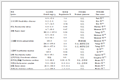
|
表 1 粉砂物理力学性质指标 Table 1 Physical mechanics property index of silty sand |
由图 3可知,考虑泊松效应影响的理论计算值更接近实测值,只是由于该算例中所取的计算点位于桩身下部而桩身轴力较小,导致有无考虑泊松效应的理论计算值差别不太明显。

|
图 3 桩侧摩阻力与相对位移关系 Fig. 3 Relations of skin resistance to relative displacement |
采用PHC500A100型管桩进行分析,初值条件取:Pz=1 000 kN,σ′vl=100 kPa,φ′=35°,δ=29°,scr=2.5 mm,υp=0.2,Ep/Gs=900,OCR=2.0。经计算,Ap=0.196 m2,Rou=0.25 m,tp=0.1 m。
3.1 超固结比对界面剪切特性的影响为了分析砂土超固结比对桩土界面剪切特性的影响,分别取超固结比为1.0、1.5、2.0、2.5、3.0进行计算。结果如图 4和图 5所示。由图可知,随着超固结比的增大,抗压桩和抗拔桩极限摩阻力近似呈线性增大,抗压桩极限摩阻力提高约83.6%,抗拔桩极限摩阻力提高约92.9%。

|
图 4 不同超固结比的τ-s曲线 Fig. 4 τ-s curves of different over-consolidation ratios |

|
图 5 超固结比对极限侧摩阻力的影响 Fig. 5 Influence of over-consolidation ratio on limit friction stress |
为了分析桩体泊松比对桩土界面剪切特性的影响,取桩体泊松比分别为0.1、0.15、0.2、0.25、0.3进行计算。结果如图 6和图 7所示。由图可知,随着泊松比的增大,抗压桩极限摩阻力呈线性增大,极限摩阻力提高约3.5%;抗拔桩极限摩阻力呈线性减小,极限摩阻力降低约3.6%。

|
图 6 不同泊松比的τ-s曲线 Fig. 6 τ-s curves of different Poisson ratios |

|
图 7 泊松比对极限侧摩阻力的影响 Fig. 7 Influence of Poisson ratio on limit friction stress |
为了分析桩土模量比对桩土界面剪切特性的影响,取桩土模量比分别为300、600、900、1 200、1 500进行计算。结果如图 8和图 9所示。由图可知,随着桩土模量比的增大,抗压桩极限摩阻力逐渐减小,极限摩阻力降低约7.6%;抗拔桩极限摩阻力逐渐增大,极限摩阻力提高约9.6%。

|
图 8 不同桩土模量比的τ-s曲线 Fig. 8 τ-s curves of different pile-soil modulus ratios |

|
图 9 桩土模量比对极限侧摩阻力的影响 Fig. 9 Influence of pile-soil modulus ratio on limit friction stress |
1) 考虑超固结比对侧压力系数的影响和泊松效应引起的侧向土压力增加值,建立了考虑超固结比及泊松效应影响的砂土管桩界面剪切模型,对其可靠性进行了验证。
2) 超固结比从1.0增大到3.0,抗压桩和抗拔桩极限摩阻力近似呈线性增大,抗压桩极限摩阻力提高约83.6%,抗拔桩极限摩阻力提高约92.9%。
3) 泊松比从0.1增大到0.3,抗压桩极限摩阻力呈线性增大,提高约3.5%;抗拔桩极限摩阻力呈线性减小,降低约3.6%。
4) 桩土模量比从300增大到1 500,抗压桩极限摩阻力逐渐减小,降低约7.6%;抗拔桩极限摩阻力逐渐增大,提高约9.6%。
| [1] |
Randolph M F, Wroth C P. Analysis of deformation of vertically loaded piles[J]. Journal of the Geotechnical Engineering Division, 1978, 104(12): 1465-1488. |
| [2] |
Kraft L M, Ray R P, Kagawa T. Theoretical development of t-z curves[J]. Journal of Geotechnical Engineering, 1981, 107(11): 1543-1561. |
| [3] |
Desai C S, Drumm E C. Cyclic testing and modeling of interface[J]. Journal of Geotechnical Engineering, 1985, 111(6): 793-815. DOI:10.1061/(ASCE)0733-9410(1985)111:6(793) |
| [4] |
Uesugi M, Kishida H, Tsubakihara Y. Friction between sand and steel under repeated loading[J]. Soils and Foundations, 1989, 29(3): 127-137. DOI:10.3208/sandf1972.29.3_127 |
| [5] |
赵明华, 何俊翘, 曹文贵, 等. 基桩竖向荷载传递模型及承载力研究[J]. 湖南大学学报(自然科学版), 2005, 32(1): 37-42. ZHAO Minghua, HE Junqiao, CAO Wengui, et al. Study on the load transfer model and the bearing capacity of vertically loaded piles[J]. Journal of Hunan University (Natural Sciences), 2005, 32(1): 37-42. (in Chinese) |
| [6] |
周宏磊, 陶连金, 王法. 非均质土层中钻孔灌注长桩竖向荷载传递模型及应用研究[J]. 土木工程学报, 2011, 44(S1): 142-146. ZHOU Honglei, TAO Lianjin, WANG Fa. Study on the load transfer model of the long pile in the heterogeneous strata in Beijing area and its engineering application[J]. China Civil Engineering Journal, 2011, 44(S1): 142-146. (in Chinese) |
| [7] |
曹卫平. 桩土界面荷载传递双曲线模型的改进及其应用[J]. 岩石力学与工程学报, 2009, 28(1): 144-151. CAO Weiping. An improved load transfer hyperbolic model for pile-soil interface and its application[J]. Chinese Journal of Rock Mechanics and Engineering, 2009, 28(1): 144-151. (in Chinese) |
| [8] |
Wong K S. The C I negative skin friction on piles in layered deposits[J]. Journal of Geotechnical Engineering, ASCE, 1995, 121(6): 457-465. DOI:10.1061/(ASCE)0733-9410(1995)121:6(457) |
| [9] |
姚文娟, 蔡晨雨. 一种新的超长桩荷载传递模型[J]. 岩土力学, 2016, 37(S2): 783-787. YAO Wenjuan, CAI Chenyu. A new load transfer model of super-long pile[J]. Rock and Soil Mechanics, 2016, 37(S2): 783-787. (in Chinese) |
| [10] |
胡琦, 凌道盛, 陈云敏, 等. 深基坑开挖对坑内基桩受力特性的影响分析[J]. 岩土力学, 2008, 29(7): 1965-1970. HU Qi, LING Daosheng, CHEN Yunming, et al. Study of loading characters of pile foundation due to unloading of deep foundation pit excavation[J]. Rock and Soil Mechanics, 2008, 29(7): 1965-1970. (in Chinese) |
| [11] |
陈明, 李镜培. 开挖卸荷桩土界面荷载传递模型的修正与验证[J]. 哈尔滨工业大学学报, 2014, 46(10): 75-80. CHEN Ming, LI Jingpei. Improved hyperbolic model of load-transfer for pile-soil interface and its verification considering deep excavation[J]. Journal of Harbin Institute of Technology, 2014, 46(10): 75-80. (in Chinese) |
| [12] |
周平槐, 杨学林. 考虑开挖卸荷影响的桩侧摩阻力等效计算方法[J]. 岩土力学, 2016, 37(10): 2952-2960. ZHOU Pinghuai, YANG Xuelin. An equivalent method for calculating side friction of pile considering excavation induced unloading effcet[J]. Rock and Soil Mechanics, 2016, 37(10): 2952-2960. (in Chinese) |
| [13] |
陈小强, 赵春风, 甘爱明. 砂土中抗拔桩与抗压桩模型试验研究[J]. 岩土力学, 2011, 32(3): 738-744. CHEN Xiaoqiang, ZHAO Chunfeng, GAN Aiming. Study of model test of uplift and compression piles in sand[J]. Rock and Soil Mechanics, 2011, 32(3): 738-744. (in Chinese) |
| [14] |
Denicola A, Randolph M F. Tensile and compressive shaft of piles in sand[J]. Journal of Geotechnical Engineering, ASCE, 1993, 119(12): 1952-1973. DOI:10.1061/(ASCE)0733-9410(1993)119:12(1952) |
| [15] |
王向军, 吴江斌, 黄茂松. 桩的泊松效应对抗拔系数λ的影响[J]. 地下空间与工程学报, 2009, 5(S2): 1545-1548. WANG Xiangjun, WU Jiangbin, HUANG Maosong. Influence of the poisson's effect on the anti-uplift coefficient of uplift piles[J]. Chinese Journal of Underground Space and Engineering, 2009, 5(S2): 1545-1548. (in Chinese) |
| [16] |
黄锋, 李广信, 郑继勤. 单桩在压与拔荷载下桩侧摩阻力的有限元计算研究[J]. 工程力学, 1999, 16(6): 97-101, 69. HUANG Feng, LI Guangxin, ZHENG Jiqing. Study on the shaft friction of single pile in compressive and tensile loading[J]. Engineering Mechanics, 1999, 16(6): 97-101, 69. (in Chinese) |
| [17] |
苏栋, 赵鹏, 高翔, 等. 考虑泊松效应影响的弹塑性荷载传递模型[J]. 岩土力学, 2015, 36(10): 2799-2803. SU Dong, ZHAO Peng, GAO Xiang, et al. An elastic-plastic load-transfer model considering Poisson's effect[J]. Rock and Soil Mechanics, 2015, 36(10): 2799-2803. (in Chinese) |
| [18] |
Yin Z Z, Zhu H, Xu G H. A study of deformation in interface between soil and concrete[J]. Computers and Geotechnics, 1995, 17(1): 75-92. DOI:10.1016/0266-352X(95)91303-L |
| [19] |
Chandler R J. The shaft friction of piles in cohesive soils in terms of effective stresses[J]. Civil Engineering and Public Works Review, 1968, 63: 48-51. |
| [20] |
姚爱敏, 王运霞. 正常固结土与超固结土主要力学特性的比较[J]. 北方工业大学学报, 2007, 19(1): 86-90. YAO Aiming, WANG Yunxia. Comparison of characteristics between normal consolidated soil and over-consolidated soil[J]. Journal of North China University of Technology, 2007, 19(1): 86-90. (in Chinese) |
| [21] |
Alawneh A S, Nusier O K, Sharo A A. Poisson's ratio effect on compressive and tensile shaft capacity of driven piles in sand:Theoretical formulation[J]. Computers and Geotechnics, 2007, 34(3): 151-163. DOI:10.1016/j.compgeo.2006.11.004 |
| [22] |
罗耀武, 胡琦, 陈云敏, 等. 基坑开挖对抗拔桩极限承载力影响的模型试验研究[J]. 岩土工程学报, 2011, 33(3): 427-432. LUO Yaowu, HU Qi, CHEN Yunming, et al. Model tests on ultimate uplift capacity of piles under excavation[J]. Chinese Journal of Geotechnical Engineering, 2011, 33(3): 427-432. (in Chinese) |
| [23] |
陈仁朋, 周万欢, 曹卫平, 等. 改进的桩土界面荷载传递双曲线模型及其在单桩负摩阻力时间效应研究中的应用[J]. 岩土工程学报, 2007, 29(6): 824-830. CHEN Renpeng, ZHOU Wanhuan, CAO Weiping, et al. Improved hyperbolic model of load-transfer for pile-soil interface and its application in study of negative friction of single piles considering time effect[J]. Chinese Journal of Geotechnical Engineering, 2007, 29(6): 824-830. (in Chinese) |
| [24] |
律文田, 王永和, 冷伍明. PHC管桩荷载传递的试验研究和数值分析[J]. 岩土力学, 2006, 27(3): 466-470. LV Wentian, WANG Yonghe, LENG Wuming. Testing and numerical analysis of load transfer mechanism of PHC pile[J]. Rock and Soil Mechanics, 2006, 27(3): 466-470. (in Chinese) |
| [25] |
《工程地质手册》编委会. 工程地质手册[M]. 第五版. 北京: 中国建筑工业出版社, 2018. Geological Engineering Handbook Editorial Board. Geological engineering handbook[M]. 5th. Beijing: China Architecture and Building Press, 2018. (in Chinese) |