 2013, Vol. 36


2. 国网长沙供电公司, 长沙 410000;
3. 电力规划设计总院, 北京 100120
2. State Grid Changsha Electric Power Company, Changsha 410000, China;
3. Electric Power Planning & Engineering Institute, Beijing 100020, China
聚合物材料被广泛应用于高压电缆绝缘系统,其内部的空间电荷是导致材料性能劣化的原因,而材料老化也会导致空间电荷的产生[1-6]。空间电荷的积累可能会导致电树枝的形成,最后导致绝缘失效[7-11]。多位学者在空间电荷对聚合物绝缘材料老化的影响方面进行了研究[12-18],但老化对材料内部空间陷阱的影响研究尚不完善,仍需进一步探索。国内外学者使用热刺激退极化电流法(TSC)对聚合物电介质陷阱信息进行了研究[19-21],TSC的原理是通过线性升温来获取电流随温度变化的图谱[20],进而求取陷阱深度和陷阱密度信息。由于该方法的升温过程对材料内部结构造成不可逆转的改变,因而作为一种破坏性测量手段,其使用受到限制。
笔者采用非破坏性的电声脉冲法(pulsed electro-acoustic,PEA)来定量测量空间电荷形成和衰减的动态过程。通过建立多能级离散陷阱模型,用去压过程电荷衰减的变化来计算材料内部陷阱深度和陷阱密度等参数,从而获取空间电荷陷阱特征参数与材料直流电老化之间的内部关系。
1 陷阱模型 1.1 电荷分布的动态平衡固体绝缘材料内部存在一系列不同深度的陷阱,某些陷阱被电荷填充,而有部分处于空置状态。对于不带电的绝缘材料,由于本身的热运动,浅陷阱内的电荷会被激发跃迁到导带中。处于导带上的电荷难以稳定,它又会跃迁至浅陷阱中,同时释放能量[22]。陷阱1中捕获电荷的变化率为
| $\frac{\text{d}{{n}_{1}}~}{\text{d}t}\text{ }=\sum\limits_{i=2}^{m}{{}}\text{ }\left[ \begin{align} & {{n}_{i}}\left( t \right)\text{ }\frac{{{N}_{1}}-{{n}_{1}}\left( t \right)}{\text{ }{{N}_{1}}}~v\exp \text{ }\left( \frac{{{U}_{i}}-{{U}_{1}}}{kT}~ \right)\text{ }- \\ & {{n}_{1}}\left( t \right)\text{ }\frac{{{N}_{i}}-{{n}_{i}}\left( t \right)}{{{N}_{i}}}\text{ }~v \\ \end{align} \right]\text{ },$ | (1) |
式中:尝试频率v=kT/h,h为普朗克常量;Ui-U1是电荷从陷阱i激发到陷阱1所需能量。
式(1) 前面部分代表电荷由能级i激发到能级1的速率;后面部分是电荷由能级1辐射跃迁到能级i的速率。
达到平衡时,电荷激发到最高能量等级陷阱的速率等于电荷从最高能级陷阱回到深陷阱的速率,即
去除外加电压,入陷的电荷逐渐减少,这就是电荷的脱陷过程。假设激发到陷阱能级1的电荷立即释放能量回到深陷阱,因此n1(t)=0。陷阱能级1中的电荷迁移率很大,导致该能级长期空置。由式(1) 可得:
| $\frac{\text{d}{{n}_{1}}~}{\text{d}t}\text{ }=\sum\limits_{i=2}^{m}{{}}{{n}_{i}}\left( t \right)v\exp \text{ }\left( \frac{U{{\prime }_{2}}-U{{\prime }_{1}}}{~kT} \right)\text{ }。$ | (2) |
因此t时刻样品中入陷的总电荷数为
| ${{n}_{\text{total}}}\left( t \right)=\sum\limits_{i=2}^{m}{{}}\text{ }{{n}_{i}}\left( t \right)=\sum\limits_{i=2}^{m}{{}}{{n}_{i}}\left( 0 \right)\text{ }\exp (-{{k}_{i}}t)。$ | (3) |
大多数文献都采用两种陷阱模型[10, 23],这种处理方式过于简单,不能很好地反映不同能级陷阱内电荷的分布状况。值得注意的是,由于PEA仪器本身的灵敏度限制,使得更浅陷阱捕获的电荷信息无法获得。
上式ki为电荷热脱陷常数,热脱陷常数为
| ${{k}_{i}}={{N}_{\text{c}}}{{v}_{i}}{{\sigma }_{\text{c}}}\exp \text{ }\left( \frac{-\text{ }{{E}_{\text{t}}}}{~kT} \right)\text{ },$ | (4) |
式中:Nc为导带中的有效能级;vi为电荷热运动速率;Et为陷阱深度;k为玻尔兹曼常数;T为温度。
热脱陷常数与电荷脱陷时间常数成反比关系,即热脱陷常数越大,时间常数越小,电荷消散就越快。
通过式(4),可以在已知脱陷率常数的前提下,求得与脱陷率常数相对应的陷阱深度水平,这对评估材料陷阱深度是非常有用的。
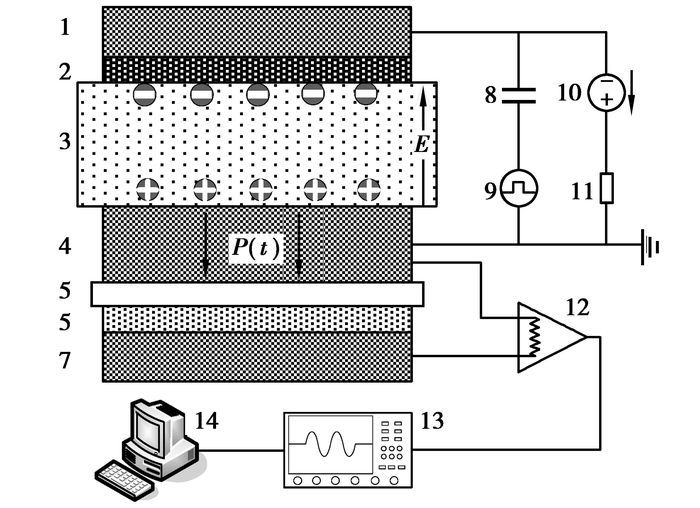
2 PEA试验及结果 2.1 PEA试验流程采用PEA测量LDPE样品的空间电荷密度分布,测量装置结构如图 1所示。
|
图 1 PEA法空间电荷测量装置结构 1.电极(铜);2.半导体层;3.待测试品;4.电极(铝);5.PVDF;6. PMMA;7.电极(铝);8.电容;9.脉冲源;10.直流高压源;11.电阻;12.前置放大器;13.Lecory WavePro 7200A示波器;14.计算机 |
测量时,脉冲源向试品施加一个高压窄脉冲,引起介质中空间电荷产生微小位移,并以声波形式传播至压电传感器,再转换为电信号后即可获取空间电荷密度分布特性。本试验中脉冲源(加拿大AVTECH公司产AVIR-1-C型号)脉冲宽度为2~5 ns,脉冲幅值为200 V,高压直流源(日本MATSUSADA公司产AU-20R3-LC型号)为0~±20 kV可调。实验声耦合剂为硅油,测量环境温度为(25±1) ℃,相对湿度为(40±2) %。
对LDPE试样(厚度约为200 μm)施加负极性高压,场强为40 kV/mm。对试样的加压时间分别为2 h,26 h和10 d,之后测量去压10~72 h内(根据样品内电荷衰减情况)的空间电荷密度分布。每个测量时间点进行1 000次测量,取其平均值作为该时间点测量结果,以消除噪声影响。
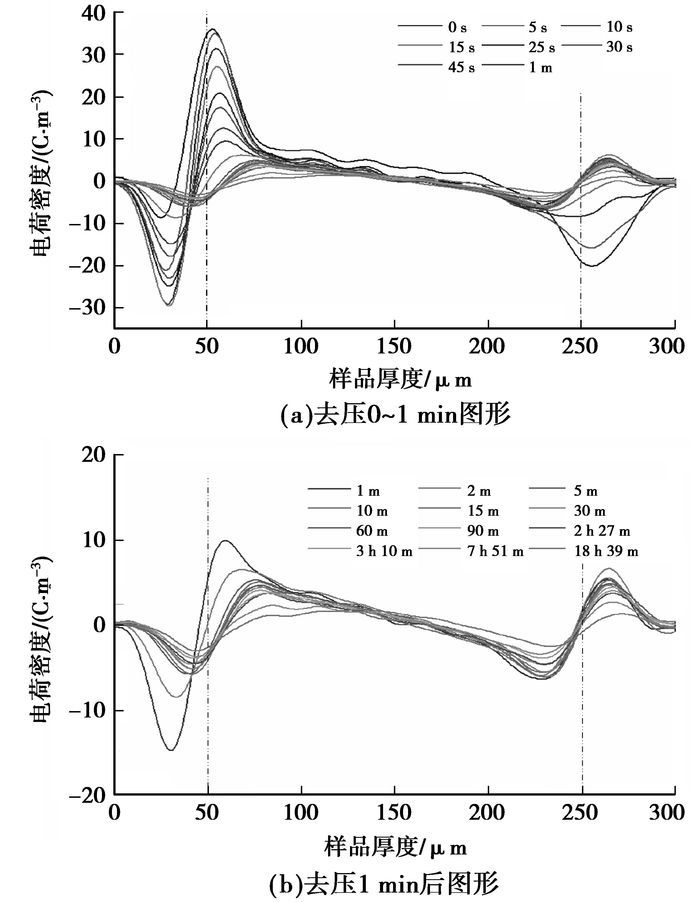
2.2 试验结果图 2是老化10 d后所获得的空间电荷衰减特性曲线(以此为例说明电荷衰减情况,由于篇幅限制,略去2 h和26 h的电荷衰减曲线)。当施加的直流电老化电压撤除后,LDPE材料内的净空间电荷持续减少。去压之初,电荷衰减非常迅速(图 2(a)),之后的衰减速率越来越慢(图 2(b))。这种现象很可能与前面描述的模型有关,即不同深度的陷阱对电荷脱陷弛豫过程的速率是有影响的。
|
图 2 空间电荷分布曲线(去压衰减过程-电老化10 d后) |
空间电荷总量及其消散快慢与绝缘材料本身微观结构有关,空间电荷对绝缘材料极性反转、击穿强度等性能存在影响。根据对图 1空间电荷密度进行积分,求得样品内电荷总量为
| $Q=\int\limits_{0}^{d}{{}}\text{ }|\rho \left( x \right)|\text{ }\cdot S\cdot \text{d}x,$ | (5) |
式中:ρ(x)为空间电荷密度;S为电极区域的面积;d为样品厚度。笔者在计算总电荷时采用了很多文献中常用的对电荷绝对值进行积分。
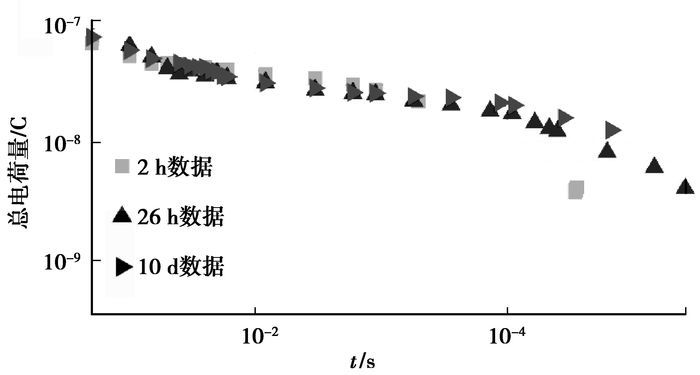
从图 3中可以看出,去压后试品内总电荷先是迅速衰减,之后呈现缓慢递减趋势,但3个不同直流电老化时间样品递减速度是不同的,老化时间越长的样品电荷消散越慢。
|
图 3 样品内总空间电荷消散曲线 |
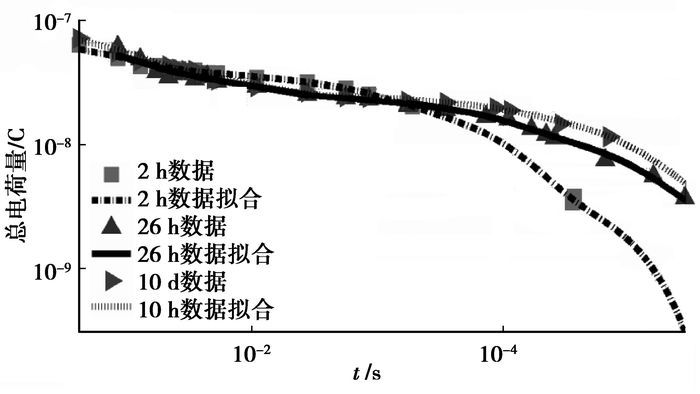
根据1.2中所建立的多能级陷阱理论,可将通过固定热脱陷常数ki来对总电荷消散曲线进行拟合,拟合优度在99%以上,拟合结果如图 4所示。
|
图 4 总电荷消散拟合曲线图 |
3种样品的电荷在去压之初都呈现极快的递减趋势。在之后很长一段时间内,老化时间越长样品内的空间电荷衰减越慢,最终都趋于零,即内部空间电荷完全消除,但老化时间长的样品需要较长时间。
图 2和图 3所展现出来的电荷衰减速度差异与样品内部的陷阱分布关系密切。通过拟合获得热脱陷常数ki相对应陷阱能级下的陷阱密度分布。
| $n\left( t \right)=Qt/\left( S\cdot d\cdot q \right)。$ | (6) |
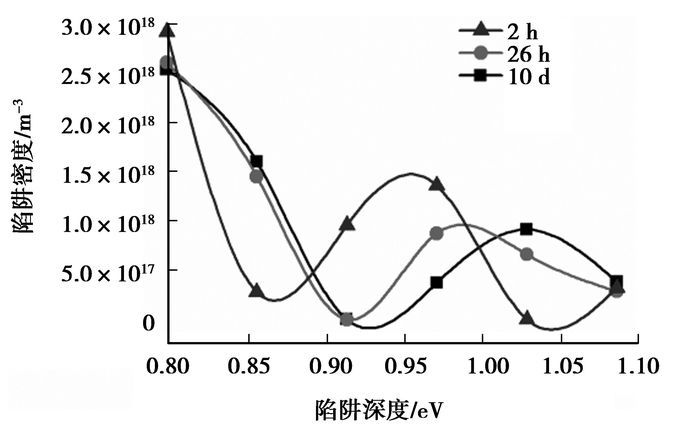
通过上式,可获得单位体积内材料的被电荷填充的陷阱密度,如图 5所示。
|
图 5 单位体积样品内不同陷阱能级中的陷阱密度 |
从图中可以明显地看出,直流电老化对材料内部陷阱的分布影响很大。直流电老化使陷阱深度约为0.8 eV的陷阱密度减少,同时大大增加了深度为0.85 eV左右的陷阱密度。陷阱密度右峰随着老化时间的增长逐步右移,从老化2 h的0.95 eV移至老化10 d的1.04 eV,深陷阱中的电荷密度逐渐增加。
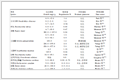
通过对单位体积内样品陷阱密度的累加,可获得单位体积内的被电荷占据的总陷阱密度,如表 1所示。
|
表 1 单位体积内入陷电荷总密度 |
虽然不同老化程度的样品空间电荷消散特性以及电荷在不同深度陷阱中的分布呈现差异,但单位体积内被电荷占据的总陷阱密度近似相等。
尽管材料单位体积内被电荷占据的总陷阱密度是相等的,但直流电老化会使电荷整体从较浅陷阱转移至逐渐增多的较深陷阱,或者是较浅陷阱转化为较深陷阱从而改变陷阱能量分布。该转移或转化过程需要更加微观的深入研究来解释。
由上述结果可知,老化改变了材料内部的陷阱分布,可用陷阱密度分布来表征老化程度。得到的低密度聚乙烯陷阱特征信息能够为改进聚乙烯材料的研究工作提供一定参考。在材料改性时可考虑通过添加相应的添加剂,来改变电荷在深浅陷阱中的分布或减少深陷阱的数量,以达到改善击穿性能和抗老化性能的目的。
4 结论通过比较直流电压下不同电老化程度低密度聚乙烯的空间电荷衰减特性,并借助于提出的离散陷阱模型,获得了能够反映老化程度的空间电荷陷阱参数,得出主要结论如下:
1) 去压后,不同直流电老化样品的入陷总电荷衰减规律均为开始快速衰减,随后电荷衰减速度随着直流电老化程度增大而减缓。
2) 随着直流电老化程度的增大,陷阱深度为0.8 eV对应的陷阱密度减少,陷阱深度为0.85 eV对应的陷阱密度增大,陷阱密度分布的峰值向陷阱深度大的方向移动。可见,直流电老化使材料电荷整体从较浅陷阱转移至逐渐增多的较深陷阱中,或者较浅陷阱转化为较深陷阱。
3) 不同直流电老化样品单位体积内,被电荷占据的总陷阱密度近似相等,直流电老化改变了材料体内的陷阱能量分布,可考虑利用不同陷阱深度下的陷阱能量分布信息来表征直流电老化程度。
| [1] | Ieda M. Carroer injection, space charge and electrical breakdown in insulating polymers[J]. IEEE Transactions on Electrical Insulation, 1987, 22(2): 261–267. |
| [2] | Bahder G, Garrity T. Physical model of electrical aging and breakdown of extruded polymeric insulated power cables[J]. IEEE Transactions on Power Apparatus and System, 1982, 101(6): 1379–1390. |
| [3] | Simoni L. A general approach to endurance of electrical insulation under temperature and voltage[J]. IEEE Transactions on Electric Insulation, 1981, 16(4): 277–289. |
| [4] | Shimizu N, Kosaki M, Horii K. Space-charge effect on local electric breakdown of polyethylene at 77K[J]. Journal of Applied Physics, 1977, 48(6): 2191–2195. DOI:10.1063/1.324020 |
| [5] | Okamoto T, Ishida M, Hozumi N. Dielectric breakdown strength affected by the lamellar configuration in XLPE insulation at a semiconducting interface[J]. IEEE Transactions on Electrical Insulation, 1989, 24(4): 599–607. DOI:10.1109/14.34194 |
| [6] | Tajitsu Y, Hosoya R, Maruyama T, et al. Huge optical rotatory power of uniaxially oriented film of poly-L-lactic acid[J]. Journal of Materials Science Letters, 1999, 18(21): 1785–1789. DOI:10.1023/A:1006691514120 |
| [7] | Fukuma M, Maeno T, Fukunaga K, et al. High repetition rate PEA system for in-situ space charge measurement during breakdown tests[J]. IEEE Transactions on Dielectrics and Electrical Insulation, 2004, 11(1): 155–159. DOI:10.1109/TDEI.2004.1266330 |
| [8] | Dakka M A, Bulinski A, Bamji S. Space charge development and breakdown in crosslinked polyrthylence under DC fields[C]//Proceedings of the Conference Record of the 2000 IEEE International Symposiμm on Electrical Insulation, April 2-5, 2000, Anaheim, CA, USA. Piscataway:IEEE Press, 2000:489-492. |
| [9] |
周远翔, 王宁华, 王云杉, 等.
固体电介质空间电荷研究进展[J]. 电工技术学报, 2008, 23(9): 16–25.
ZHOU Yuanxiang, WANG Ninghua, WANG Yunshan, et al. Review of research on space charge in solid dielectrics[J]. Transactions of China Electrotechnical Society, 2008, 23(9): 16–25. (in Chinese) |
| [10] | Antonios T, Simon M R, Leonard A D, et al. The effect of dc poling duration on space charge relaxation in virgin XLPE cable peelings[J]. Journal of Physics D:Applied Physics, 2010, 43(21): 215401. DOI:10.1088/0022-3727/43/21/215401 |
| [11] | Montanari G C. Relation between space charge and polymeric insulation ageing:cause and effect[J]. IEE Proceeding-Science, Measurement and Technology, 2003, 150(2): 53–57. DOI:10.1049/ip-smt:20030146 |
| [12] |
刘子玉, 刘荣生, 王惠明, 等.
空间电荷与电树枝的引发[J]. 西安交通大学学报, 1985, 19(5): 25–33.
LIU Ziyu, LIU Rongsheng, WANG Huiming, et al. Space charges and initiation of electrical trees[J]. Journal of Xi'an Jiaotong Uuniversity, 1985, 19(5): 25–33. (in Chinese) |
| [13] |
陈少卿, 谭诗田, 王闯.
聚合物材料中电树枝的研究[J]. 绝缘材料, 2007, 40(6): 57–60.
CHEN Shaoqing, TAN Shitian, WANG Chuang. Research of electrical tree in polymer[J]. Insulating Material, 2007, 40(6): 57–60. (in Chinese) |
| [14] | Mazzanti G, Montanari G C. Electrical aging and life models:the role of space charge[J]. IEEE Transactions on Dielectrics and Electrical Insulation, 2005, 12(5): 876–890. DOI:10.1109/TDEI.2005.1522183 |
| [15] | Li J X, Zhang Y W, Xia Z F, et al. Action of space charge on aging and breakdown of polymers[J]. Chinese Science Bulletin, 2001, 46(10): 796–800. DOI:10.1007/BF02900426 |
| [16] | Dissado L A, Mazzanti G, Montanari G C. The Role of trapped space charges in the electrical aging of insulating materials[J]. IEEE Transactions on Dielectrics and Electrical Insulation, 1997, 4(5): 496–506. DOI:10.1109/94.625642 |
| [17] |
尹毅, 肖登民, 屠德民.
空间电荷在评估绝缘聚合物电老化程度中的应用研究[J]. 中国电机工程学报, 2002, 22(1): 43–48.
YIN Yi, XIAO Dengming, TU Demin. An application of space charge in valuing the electric ageing degree of insulating polymer[J]. Proceedings of the Science for Electrical Engineering, 2002, 22(1): 43–48. (in Chinese) |
| [18] |
杨强, 安振连, 郑飞虎, 等.
线性低密度聚乙烯中空间电荷陷阱的能量分布与空间电荷的关系[J]. 物理学报, 2008, 57(6): 3834–3839.
YANG Qiang, AN ZhenLian, ZHENG FeiHu, et al. The relationship between energy distribution and space distribution of charge traps in linear low density polyethylene[J]. Acta Physica Sinica, 2008, 57(6): 3834–3839. DOI:10.7498/aps.57.3834 (in Chinese) |
| [19] | Lanca M C, Neagu E R, Neagu R M, et al. Space charge studies in LDPE using combined isothermal and non-isothermal current measurements[J]. IEEE Transactions on Dielectrics and Electrical Insulation, 2004, 11(1): 25–34. DOI:10.1109/TDEI.2004.1266313 |
| [20] | Chen G J, Xia Z F, Zhang Y W, et al. The study of the open-circuit thermally stimulated discharge on the guest-host nonlinear optical polymer electret DRl/PMMA film[J]. 10th International Symposium on Electrets, 1999: 383–386. |
| [21] | Mizutani T, Suzuoki Y, Hanai M, et al. Determination of trapping parameters from TSC in polyethylene[J]. Japanese Journal Applied Physics, 1982, 1982(11): 1639–1641. |
| [22] | Mauanti G, Montanari G C, Alison J M. A space-charge based method for the estimation of apparent mobility and trap depth as markers for insulation degradation-theoretical basis and experimental validation[J]. IEEE Transactions on Dielectrics and Electrical Insulation, 2003, 10(2): 187–197. DOI:10.1109/TDEI.2003.1194099 |
| [23] | Zhou T C, George C, Liao R J. Calculation and analysis of two level traps model in polymeric materials[C/OL]//Proceedings of the 15th Asian Conference on Electrical Discharge, November 7-11, 2010, Xian, China, http://eprints.soton.ac.uk/271821/. |